

Faith Doesn’t Need a Payment Plan
Faith > Pledge
One of the most fascinating things churches do at the end of the year is call something a “faith offering”… and then immediately turn it into math.
“We’re believing God for a miracle.”
Awesome.
“So here’s how you can divide your gift into 12 manageable monthly installments.”
Wait.
I’m not anti-planning.
I’m not anti-budgeting.
I’m not anti-consistency.
But somewhere along the way, many churches unintentionally shifted year-end generosity from an act of faith into a transaction strategy.
That’s why so many giving campaigns feel flat.
(and that you call it a “campaign.” As if that word ever excites anyone)
Not because people are selfish.
Not because churches lack vision.
Not because the economy is bad.
It’s because the emotional and spiritual posture has quietly changed.
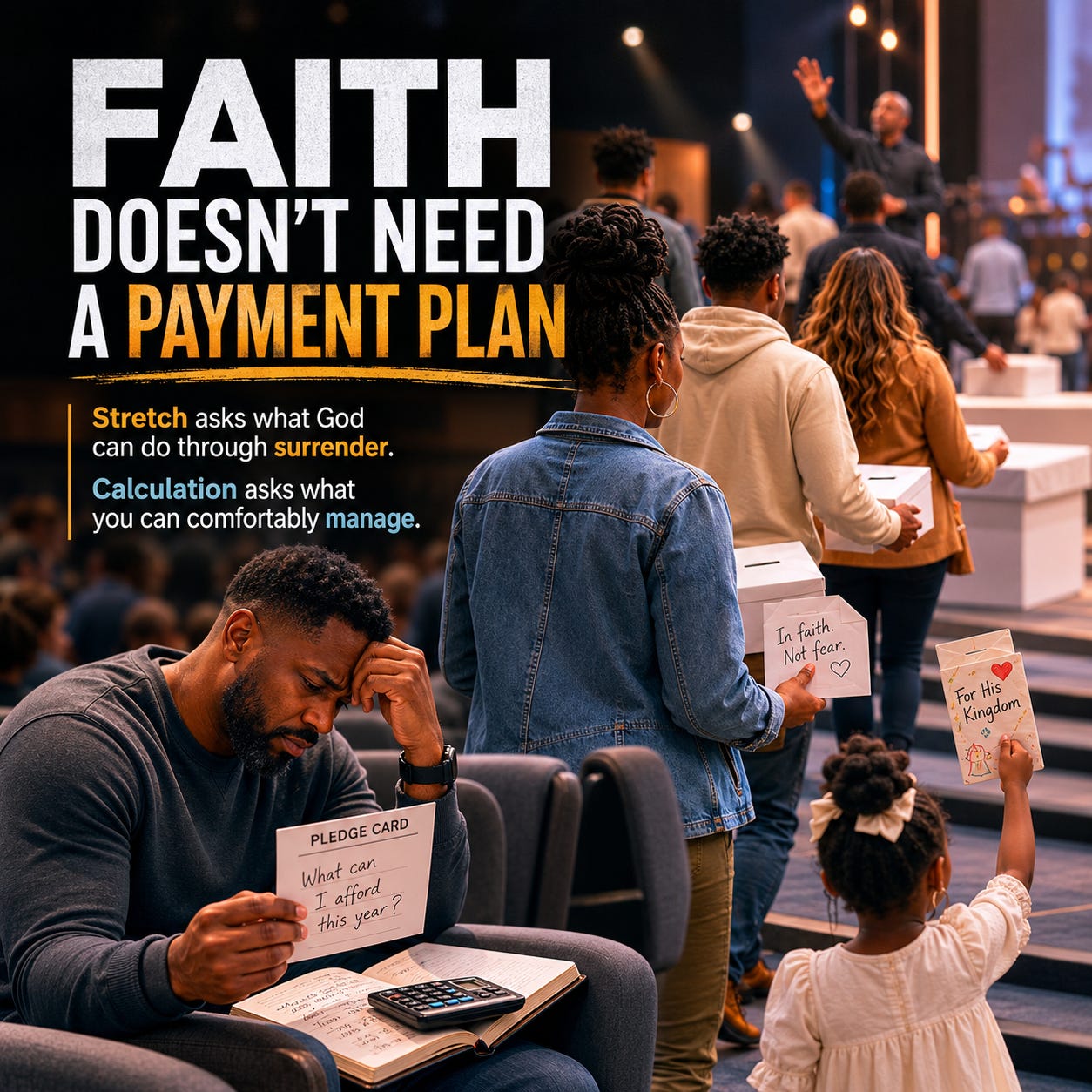
A lot of churches are no longer challenging people to stretch.
They’re coaching people to calculate.
There’s a difference.
Stretch asks:
“What could God do through surrender?”
”What is God telling us to give that hurts?”
Calculation asks:
“What can I comfortably manage without changing anything?”
”How many Starbucks can we give up to give a little more?”
Those are not the same conversation.
And before somebody gets nervous, let me say this clearly:
I’m grateful for every gift.
A tithe matters.
A recurring gift matters.
A one-time offering matters.
This isn’t about shaming people.
It’s about recognizing that many churches have accidentally built generosity cultures around safety instead of faith.
That’s why I’m increasingly uncomfortable with the language and psychology around pledges.
Because in many cases, pledging isn’t really generosity.
It’s deferred logic.
“I can’t give $5,000 today… but I can promise to slowly pay it over time.”
Again, I’m not saying that’s evil.
I’m saying it’s worth asking:
Is that faith?
Or is that just manageable math?
The widow in scripture didn’t pledge two mites over 18 months.
The boy didn’t pledge to divide his fish and loaves.
The widow didn’t pledge to divide her oil easily over 6 months.
Mary didn’t pledge a few sprays and spritzes on Jesus, she broke the bottle.
Faith almost always has a “NOW” component to it.
A surrender component.
A stretch component.
Not reckless, manipulative, or emotionally weird.
But real.
And here’s the deeper issue:
Many churches unknowingly reinforce this small thinking because they approach generosity transactionally.
“If you give, we can finally do ministry.”
No.
The church should already be doing ministry.
We should already be feeding people.
Already supporting missions.
Already helping families.
Already reaching cities.
That’s called stewardship.
Year-end generosity should not feel like paying the church’s bills.
It should feel like running through the finish line with faith.
That’s why I love year-end giving so much.
It’s not really about money.
It’s about alignment.
Sacrifice.
Stretch.
Expectation.
Leadership.
Vision.
Trust.
It’s a moment where people decide:
“Are we coasting into next year?”
Or:
“Are we finishing strong?”
That’s a completely different atmosphere.
And leaders have to go first.
Not because they’re rich.
Not because they get special treatment.
Because leaders go first.
That’s what leadership is.
The healthiest generosity cultures I’ve seen are not built on pressure.
They’re built on conviction.
They feel invited into something meaningful.
And the church stops sounding like a fundraiser.
It starts sounding like a faith movement.
That shift matters.
A lot.
Swell: August 10–11
This is exactly the kind of conversation we’re diving into at Swell.
Swell is a small, high-level intensive built specifically for church leaders who want to rethink year-end generosity, momentum, vision language, and how to build a healthier culture of giving.
Not gimmicks.
Not scripts.
Not emotional manipulation.
Real strategy.
Real philosophy.
Real conversations.
We’ll walk through:
Year-end giving structure
Momentum timing
Leadership communication
Donor psychology
Generosity culture
Vision framing
Language shifts
What actually moves the needle
And probably most importantly… how to lead people into faith instead of just another transaction.
August 10–11.
Small room.
Limited churches.